

Air in, air through, air out: the full route matters
A radiator works best when the car can catch clean air, push it through the core and then let that hot air leave without fighting back under the bonnet. If any part of that route is messy, the water temperature climbs harder than the core size would suggest. On a Midrand build, we often look at the nose opening first, then the space behind the radiator and finally the bonnet or undertray exit path.
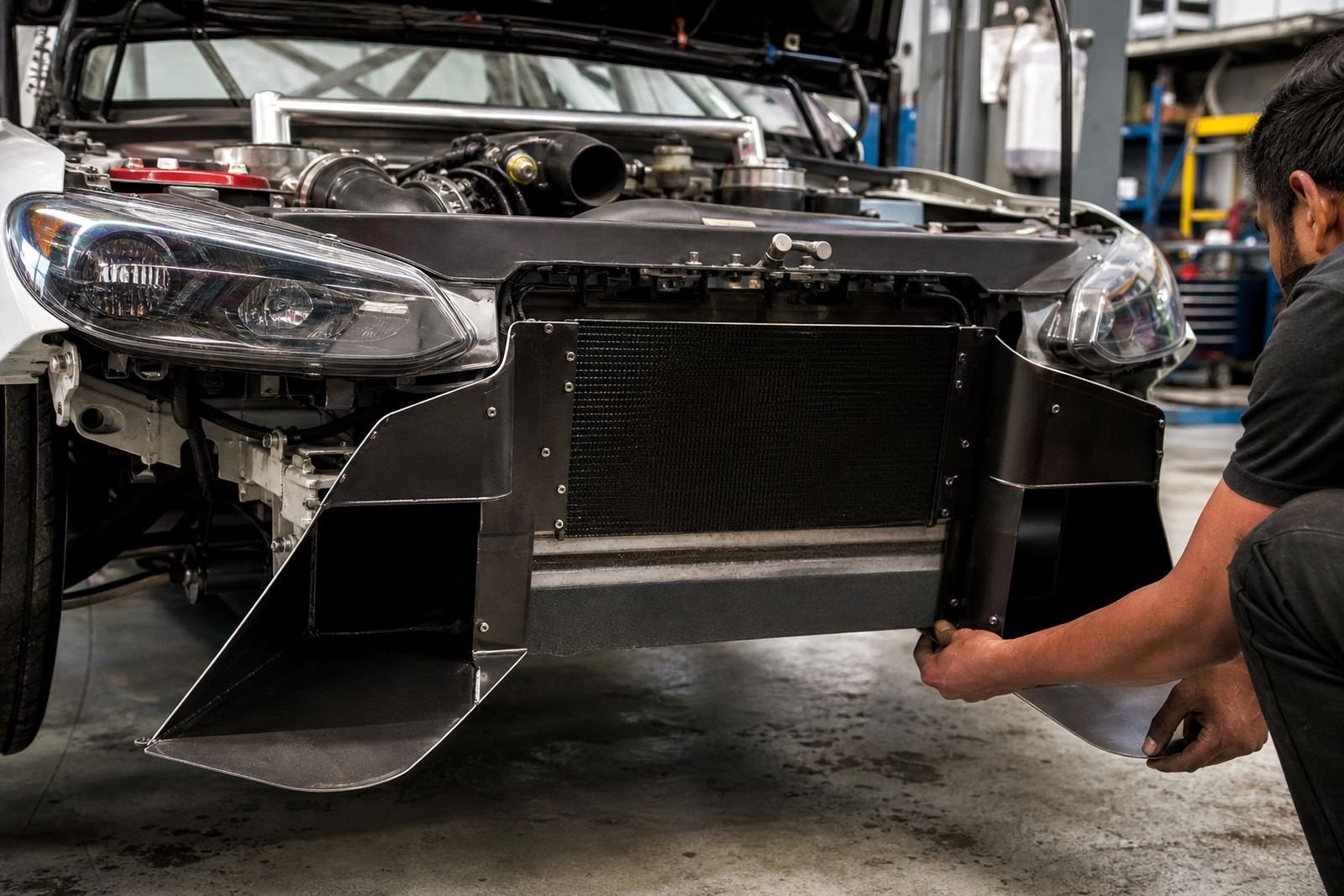
Many cars run a decent core but still struggle because air spills around the sides instead of passing through the fins. A strip of aluminium, foam seal or a shaped duct can force more of the incoming air where it belongs. That work matters on club cars running Kyalami days, and it matters on rally cars that see slower sections, dust and longer pulls under load.
Core size helps, but poor ducting can waste it
It is tempting to think that a larger core solves everything. In practice, a wide but poorly fed radiator can underperform a smaller unit with clean ducting and a proper exit. The goal is not just more cooling area, it is controlled airflow across the whole face of the core.
- Seal the gap between the nose opening and the radiator frame
- Stop air from slipping around the sides and over the top
- Keep the core clear of bent fins and blocked debris
- Make sure the fan shroud does not choke the main air path
- Leave a clear path for hot air to escape after the core
On front engined cars, a sloppy fit can cause hot air to sit in the engine bay and recycle through the radiator. That is common on tight club racing builds where front mount coolers, lights or extra brackets have crowded the opening. Small changes can bring the temperatures down more neatly than jumping straight to a larger core.
Bonnet vents, undertrays and the pressure picture
Airflow through the radiator depends on pressure difference. You want a higher pressure zone in front of the core and a lower pressure zone behind it. If the engine bay is sealed badly, or the undertray traps hot air, the radiator ends up working against a wall of pressure instead of a clean pull.
Bonnet louvres can help, but only when they sit in the right place. Put them where hot air naturally gathers and they can relieve pressure without making the front end lift at speed. Undertray exits can also work well, especially on track cars that run a splitter and need tidy airflow under the nose. Test it before cutting more, because one bad cut can reduce cooling and upset front end balance at the same time.
Fans and shrouds should support flow, not fight it
Electric fans are useful in the pits, in traffic and during slow in-lap conditions. Poor ducting is not fixed by them. If the shroud is too small, too close or badly positioned, the fan can pull air from the wrong place and leave the outer parts of the core doing very little.
- Match the shroud to the active core area
- Keep the fan blades clear of obstructions
- Check the fan direction after installation
- Allow enough room so the motor does not sit against the fins
- Make sure wiring and mounting points do not block the airflow route
For many racers, a well placed shroud and a tidy exit path give better real world results than a fan that simply moves more air on paper. That becomes more important on endurance style club events, where heat soak builds over repeated sessions and the car cannot rely on one cool lap to reset everything.
Cooling system checks that belong on every setup day
Cooling system checks should not stop at the radiator. Hose routing, cap condition, header tank position and thermostat choice all influence how the system behaves under pressure. A trapped air pocket can mimic a bad radiator, while a weak cap can upset boiling point and cause the car to spill coolant earlier than expected.
On a setup day, we usually look at the full package: coolant path, airflow path and how the car behaves once it is under braking and acceleration. A car that feels fine on a short road test may show a very different pattern after a few hard laps. That is where the practical reading comes in, because the cooling system has to suit the way the car is driven, not just how it looks in the bay.
Fixing heat at Kyalami without a bigger radiator
A front engined club car arriving from Kyalami may look as though it needs a much larger radiator. After checking the installation, the real issue is often that air enters through the nose, hits a loose panel and escapes around the core before doing useful work. The fix can be a combination of sealing panels, better duct shape and a cleaner exit under the bonnet.
That approach keeps the front of the car neater and often preserves space for brake ducts, oil coolers and other hardware that also needs air. It also avoids the weight and packaging penalties that come with fitting a much bigger core just to compensate for poor management elsewhere.
For Midrand, Johannesburg and Pretoria cars that do mixed track and road use, the best result is usually a cooling package that looks a little boring but works hard. Straight air path, no leaks around the edges and no trapped hot air in the bay.
Where RaceHouse fits into a cooling setup
Our workshop team works through radiator airflow paths as part of wider cooling system checks and track setup days. That includes advice on ducting, hose layout, fan placement and how the car should breathe once it is at speed. The same car can need a different approach for sprint work, rally stages or club racing on a hot Gauteng afternoon.
We also look at nearby systems that affect heat load, like brake ducts, oil coolers and front end packaging around the nose. When those parts are crowded together, airflow has to be managed properly or the whole front of the car starts competing for the same air. A sensible layout saves time later and makes the temperature readings easier to trust.
- Brake Upgrade Planning
- Cooling System Checks
- Track Setup Days
- Alignment Checks
- Corner Weighting
Drivers from Midrand, Centurion, Kyalami, Durban, Cape Town and Port Elizabeth often face very different conditions, from humid coastal air to hotter inland circuits. The radiator does not care where the car came from, but it does care how the air is guided through the nose and out the back.