

Where the fuel cell sits in the car
Good fuel cell placement begins with the shape of the chassis and the way the car is driven. A cell that sits too far rearward can punish the back axle on rough rally stages, while one placed too high can leave the fill point awkward and the fuel surge worse when the tank level drops. In a club car that sees track days and road transit, the aim is to keep the mass low, protected and easy to inspect without tearing half the trim apart.
We also look at what else lives in the same area. Harness anchor points, a rear strut brace, rear suspension movement and spare wheel wells all affect the final position. On some cars the best answer is a compact cell with a proper cradle and a simple service path. On others, the safest answer is a custom tray that keeps the lines away from heat and moving parts.
Safe mounting beats a neat-looking shortcut
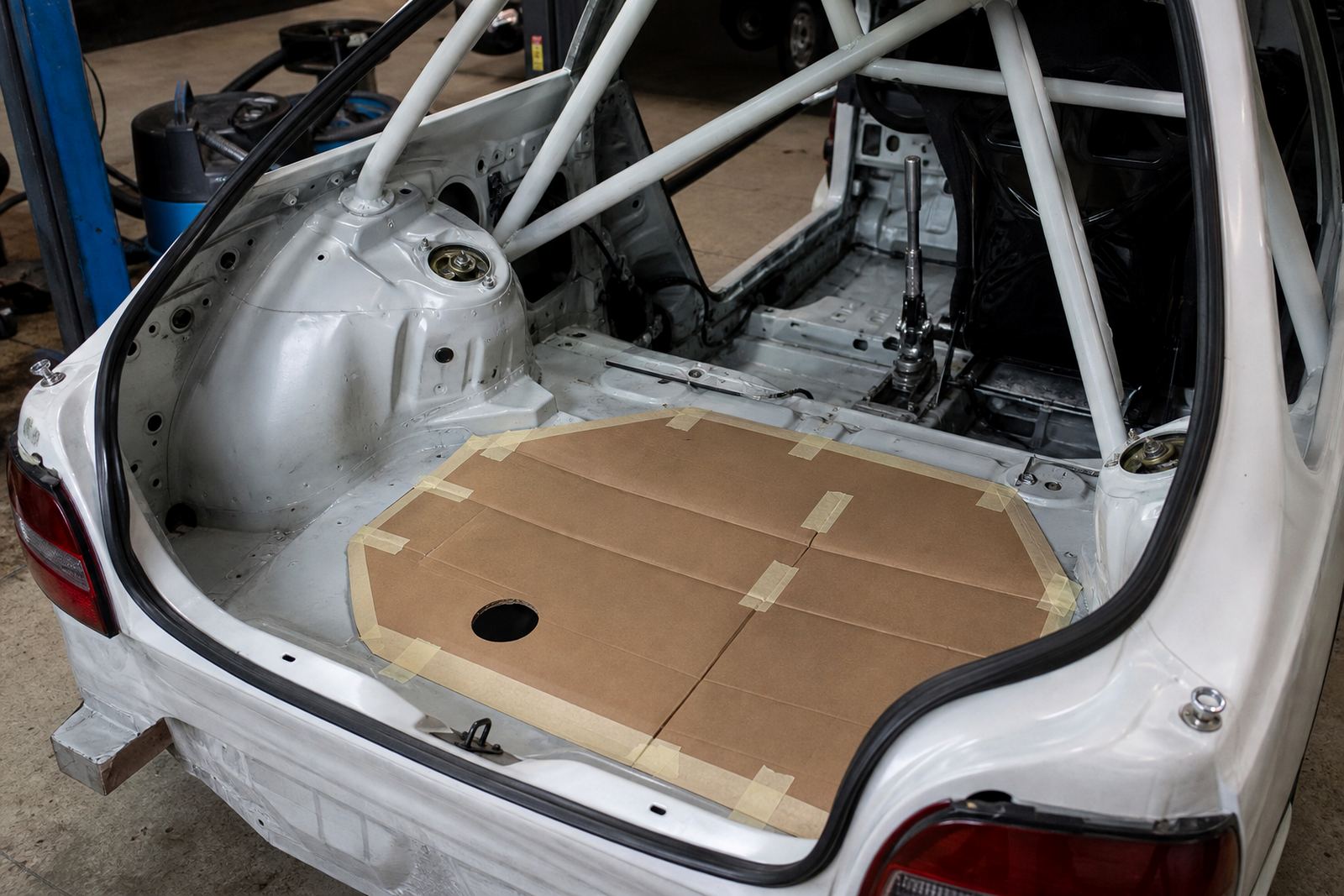
A fuel cell should be restrained properly, with a solid base and positive retention that suits the shell. Foam packing alone does not hold a cell in place, and loose brackets can work themselves hard on corrugated roads or over kerbs at Kyalami. We look at the boot floor, nearby seams and how load is carried into the body. On cars with older sheet metal, the mounting points need careful checking before any holes are drilled.
The cell itself needs room to breathe. If it is trapped against metal with no allowance for movement, the fixings can fret the shell. If it sits on soft material without structure, it can shift under braking and cornering. That is where a proper cradle, spreader plates and decent hardware matter more than guesswork.
- Use a stable base with spread load across the floor
- Keep the cell clear of sharp edges and chafing points
- Allow room for inspection of fasteners and seals
- Check that the filler neck and vent do not rub on panels
Fill access must work in the pit lane and under a canopy
Fill access sounds obvious until the first refuel at a busy circuit. The filler cap needs a clear path, a sensible neck angle and enough space for the nozzle or transfer system used by the team. If the cap sits too deep in the bodywork, spills become harder to manage. If it sits too close to a hot panel or exhaust route, heat soak becomes part of the routine and that is not useful.
For rally and endurance use, we look at how the cap can be reached with gloves on and how the venting behaves when the car stands on an incline. In a Midrand workshop, a customer may think the cap location is fine, then find it awkward once the car is on a trailer or parked on a cambered surface. A practical placement makes filling calmer, cleaner and easier to inspect after each session.
- Keep the cap easy to reach without leaning across bodywork
- Avoid placing the neck near exhaust heat or sharp body edges
- Check vent routing so fuel does not burp back on fill
- Make sure the access panel can be opened without disturbing other parts
Line routing needs to stay cool, protected and easy to trace
Fuel lines should follow the safest path, not the shortest one. They need protection from stone strike, road debris, harness hardware and suspension movement. On a track car, a clean route along the shell can work well if the line is clipped properly and kept away from heat sources. On a rally car, extra shielding and more frequent inspection points are sensible because the car takes a harder life on dirt, gravel and rough tar.
We pay close attention to where the line crosses the rear floor, where it passes near the diff and how it enters the cabin side if the design requires it. Every bend should make sense when the car is lifted for service. If the line cannot be traced without removing half the trim, the next leak check becomes a nuisance.
Clips, grommets and heat sleeves are not decoration. They reduce wear and help the system stay tidy after a season of hard use.
Placement must work with seats, harnesses and the cage
Fuel cell placement affects more than fuel delivery. It changes how a seat mounts, where the harnesses travel and whether the roll cage or rear stays have enough clearance. In some builds, the rear bulkhead area gets crowded quickly once a cage, fire bottle bracket and electrical cut-off are added. That is why the tank position should be planned with the whole cabin in mind, not as a separate job.
A proper layout keeps the driver area free of unnecessary interference. It should not force the harnesses into odd angles or create a seat position that pushes the driver too far forward. If the car is used at Kyalami one weekend and on a fast national road section the next, the cockpit still has to feel settled and predictable.
Our team often checks the fuel cell with the seat shell, belts and cage tubes in place, because the final fit rarely makes sense on paper alone. That includes a look at access to the pump, sender and service panels.
Boot floor or rear seat well, a Centurion car
A club racing customer from Centurion brought in a rear-wheel-drive coupe that had already been fitted with a basic cell, but the fill point was awkward and the line ran too close to the exhaust tunnel. On paper the setup looked workable, yet the first inspection showed that the cap sat under a panel lip and the vent pipe had a sharp bend that made refuelling messy. The cell also sat a touch too high, which reduced boot clearance for the rear brace and made inspection awkward.
We rethought the placement with three things in mind: lower mass, better access and simpler line tracing. The revised layout kept the cell secure, moved the filler to a clearer position and gave the fuel lines a cleaner route past heat. The car did not need a complicated solution, just a better one that suited the shell and the way it was being used.
That is the sort of job where our contact form is useful, because the brief can include photos, the car model and a note on how the car runs on track or rally stages.
The checks that belong in the same appointment
Fuel cell placement is best handled alongside the other checks that affect safety and balance. Once the tank position is sorted, it makes sense to look at the clutch setup, rear brake routing, suspension clearance and any corner-weight concerns that can show up after a weight shift. A car that carries more fuel mass in one area may behave differently under braking and through fast direction changes.
We plan the cell around the rest of the car. That means looking at fill access, venting, hose routing and service access in one pass. It also means the final arrangement should suit the car’s real workload, whether that is track sessions in Johannesburg, rally use near Pretoria or long-distance transport from Cape Town or Durban for a race weekend.
- Check for chafe points after the first heat cycle
- Inspect fasteners and straps with the car on stands
- Confirm the vent path still clears bodywork and trim
- Review access to pump, sender and isolator points
What a proper fuel cell layout leaves you with
A sensible fuel cell layout does not draw attention to itself. It gives the driver a safer fuel system, easier service access and fewer surprises when the car is tipped into a corner or loaded for transport. The best result is usually the one that looks plain, because every part has a clear job and nothing is fighting for space.
For drivers in Midrand, Johannesburg, Pretoria, Kyalami, Durban, Cape Town and Port Elizabeth, the real question is not only where the cell will fit, but how the full rear end will work around it. That includes the filler, the vents, the lines and the parts that share the same corner of the car. When those details are planned together, the car feels more settled and the workshop time is spent on the right things.
If you are comparing mounting ideas, fitting access or line routing, bring the photos and measurements into our contact form and we can work through the layout from there.