

What corner weighting is really measuring
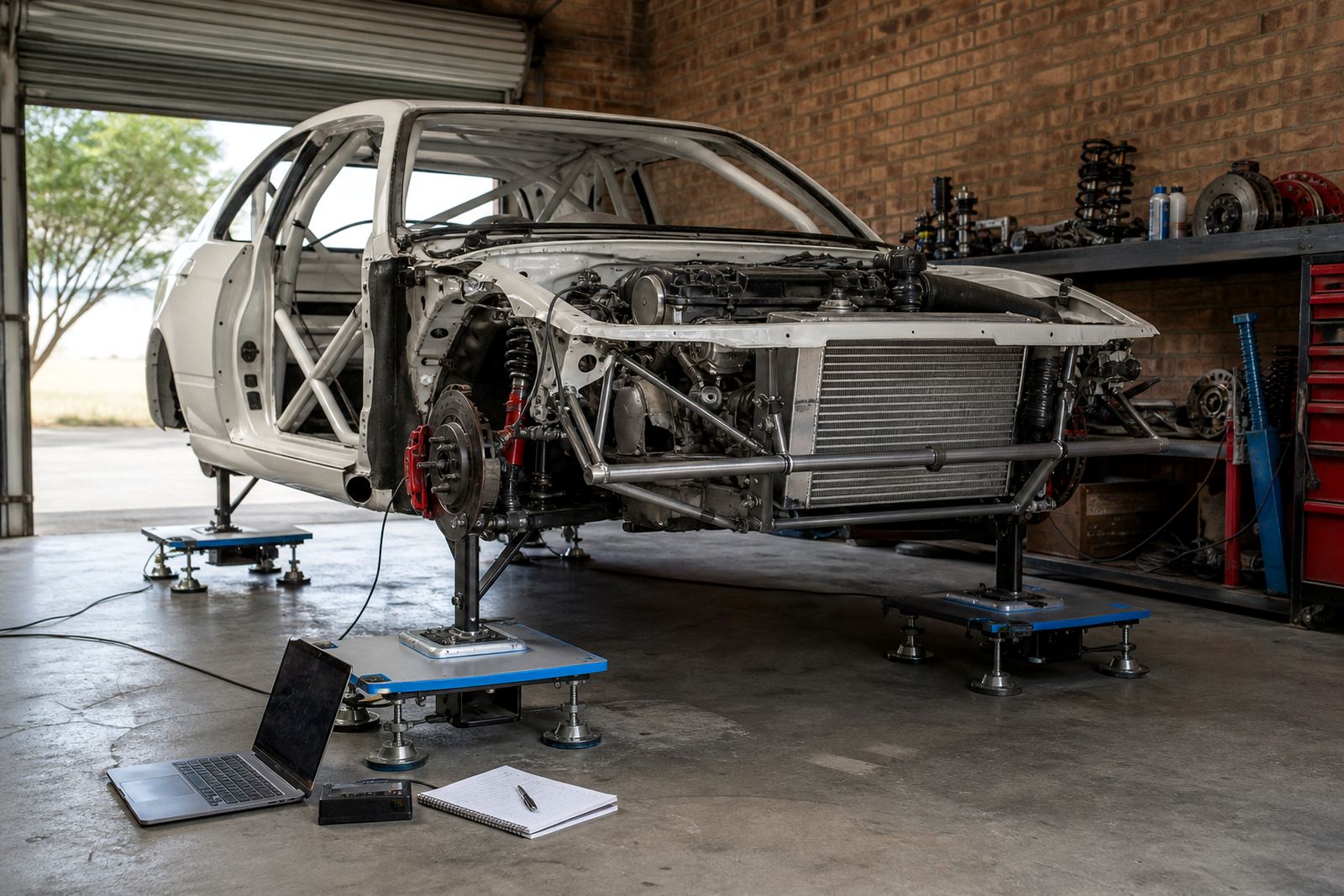
Corner weighting checks how much load each wheel carries when the car sits ready to run. It is done with the driver weight or ballast in place, the fuel level set to a known mark, and the suspension settled on flat scales. The numbers tell you how the chassis sits left to right and front to rear, not just whether the car looks level on the floor.
Many drivers first notice the value after fitting coilovers, lowering springs, bushes or a roll cage. Those parts change how the shell carries weight, and sometimes the difference from one corner to the next is larger than expected. A car can feel tidy on the road yet still pull under braking or take a long time to settle into a fast corner.
- Left-right balance affects turn-in and mid-corner grip.
- Front-rear split changes how the car reacts under braking and acceleration.
- Driver position, seat mounts and harness fitment all play a part.
- Tyre pressures and fuel load should be kept consistent during checks.
When a small imbalance starts to show up on track
A modest club racer does not need a dramatic problem before corner weighting matters. A few kilograms out on one corner can show up as a car that feels planted in one direction and nervous in the other. On a tight circuit or a rally stage, that can mean extra steering correction, uneven front tyre wear and a rear end that reacts differently through repeated transitions.
In Gauteng, we see this often after suspension changes or a safety refresh. A car may have new bushes, a fuel cell conversion, or a proper seat and harness package, yet the driver still reports a strange feel through sweepers. The issue is not always spring rate or damper setting. Sometimes the chassis is simply carrying the weight unevenly.
Corner weighting is also useful after body repairs or any work that changes mounted parts on one side. Even a careful repair can shift the way the shell sits, especially on older track cars and rally shells that have already seen plenty of use.
The workshop steps that make the numbers useful
Good results begin before the scales go under the car. The tyres should be at the pressures you plan to run for the session, the fuel level should be repeatable, and the car should be on a flat surface. If the ride heights are wildly uneven, or a spring perch is locked off in the wrong spot, the numbers will only tell part of the story.
From there, the process is a cycle of measurement and adjustment. Small changes at one corner often influence the opposite side, so the work needs patience and a clear plan. After each change, the car should be rolled and settled again before taking the next reading.
- Check ride height at all four corners before adjusting loads.
- Make small changes at the spring perches or platform collars.
- Recheck the cross-weight after each adjustment.
- Keep steering angle centred and suspension free of binding.
- Record the final settings for later track days or rally events.
How it ties into brakes, alignment and coilover setup
Corner weighting does not sit alone. It works with alignment checks, brake upgrade planning and coilover setup, because each part changes how the car loads up in motion. A car with the correct balance but poor toe settings can still feel vague. A car with excellent brakes but a poor cross-weight can lock one front wheel sooner than the other.
That is why the best setup days move in stages. The suspension is set first, then the alignment is checked, then the brakes and corner weights are reviewed together. On a car with a fresh set of brake pads and fluid, the driver can feel the difference more clearly because the pedal and chassis are speaking the same language.
It also matters for clutch and shift setup. If the driver is fighting the car through corners, the whole lap feels heavier than it should. A balanced chassis gives cleaner inputs, which makes every other system easier to judge.
A club racer on the scales
A Johannesburg-based club racer came to our Midrand base with a lightweight sedan used for sprints and short circuit events. The car had suspension work done, a proper seat, harnesses and a roll cage, but it still felt inconsistent on left-hand turns. The driver said the car rotated cleanly one way and pushed the other, especially on entry.
After checking ride heights and settling the suspension, the cross-weight was adjusted in small steps. We also reviewed seat position, since the driver sat slightly offset, and confirmed the fuel load used for the setup day. Once the numbers were closer, the car felt calmer under braking and more predictable through direction changes. Nothing dramatic changed visually, but the driver could place the car with less effort.
That is the point for many local racers. You are not chasing a magazine figure. You are trying to make the car behave the same way in both directions, on a warm day at Kyalami or a damp event in Durban.
What drivers should pay attention to after the setup
After corner weighting, the car should be driven with attention to familiar markers. The steering may feel lighter or more direct, and the rear may settle differently in quick transitions. If something feels off, it is usually worth checking tyre pressures, suspension fasteners and the seating position before assuming the setup is wrong.
It helps to keep notes from each run. Track conditions, fuel load, damper clicks, tyre brand and brake feel all affect the impression. Over time, the pattern becomes easier to read, and setup decisions become less guesswork and more repeatable work.
- Watch for pull under braking or turn-in hesitation.
- Look at tyre temperature spread after a session.
- Check for rubbing, binding or loose mount points.
- Keep the same driver position when comparing setups.
When corner weighting earns its place in the build budget
It is easy to spend on shiny parts and leave the chassis balance for later. Yet corner weighting often gives more useful pace than a small power increase, especially in club racing where consistency matters. A well-sorted car is easier on tyres, easier on the driver and easier to tune for different circuits.
For racers across South Africa, from Midrand and Centurion to Pretoria, Kyalami, Durban and Cape Town, the value is the same. If the car is built for laps, stages or club weekends, the way it sits on its wheels matters as much as the parts under the bonnet. A careful setup can make ordinary hardware work far better than expected.