

Start with the class rules, not the catalogue
Before you look at sizes and fittings, check the regulations for the car and class. Some series allow a fuel cell in the standard tank area, others are strict about position, enclosure and vent routing. A club car used for sprints may have more freedom than a rally car that needs tougher protection from stones, mud and repeated vibration.
Think about how the car runs lap to lap as well. A short sprint car, a drift car, and a longer circuit car do not always need the same reserve. A cell that is too large adds weight high in the chassis and can make the rear of the car feel heavy once fuel sloshes around. Too small and you spend the day refuelling more often than you planned, which is not ideal during a busy race meeting.
Capacity should suit stint length and packaging
Capacity is usually the first number people focus on, yet it only makes sense when matched to the car. A larger cell can help with race distance and fuel surge control, but the tank still needs to sit where the chassis can carry it properly. The right size depends on engine use, fuel consumption and the room available once the rear bulkhead, spare wheel well or boot floor are measured properly.
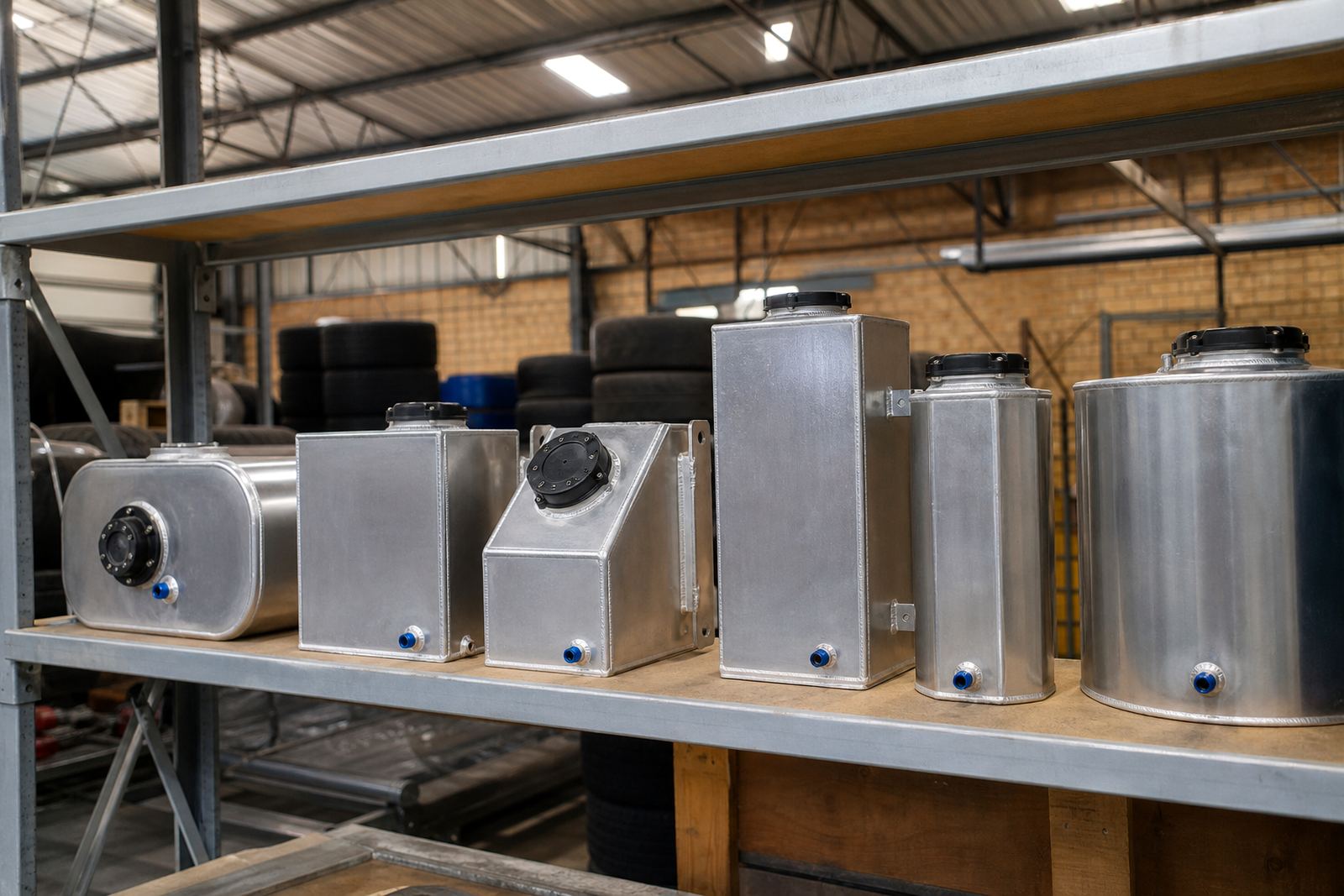
In a compact shell, a smaller cell with the right internal baffling can work better than forcing in a larger unit. A taller cell may fit the volume you want, but it can interfere with boot lids, service access or suspension movement. On some builds the smart choice is a lower, wider shape that spreads the load and keeps the filler where a filler cap can be reached without awkward body changes.
- Measure the available footprint, height and depth before choosing a size.
- Allow for foam, baffles and the space needed around the outlet and vent fittings.
- Check whether the car needs more range or better balance on long stints.
Shape, baffling and fuel control on corner entry
Shape does more than fill a space. A good cell helps keep fuel near the pickup under braking, turn-in and acceleration. That matters when a car is driven hard through long corners or over rough rally stages. Baffling and internal foam help reduce surge, so the pump is less likely to uncover when the tank level drops.
Look at the shape from a practical fitting point of view too. Squared edges can use space well, but they may need more careful mounting and padding. Rounded or stepped designs can clear suspension towers, crossmembers or boot lids more easily. If the car has a shallow rear area, a low-profile cell may be the only sensible option. The important part is that the shape fits the car without forcing the installer to compromise on access or safety.
Filler position and vent routing need real thought
Filler position affects both safety and convenience. A top-mounted filler may suit one car, while a remote filler can make more sense on another. The aim is to keep refuelling clean, secure and simple to reach without opening panels that do not need to be removed at the track. On rally cars, the filler often needs to sit where dirt and water will not be thrown straight at it.
Vent routing matters just as much. If the vent is poorly placed, fuel smell, pressure build-up or spill issues can follow. A tidy vent line, fitted with proper support and protection, helps the system behave properly when the car corners hard or sits in the sun between sessions. On a race car, a loose line is never a small detail.
- Check that the filler cap can be reached without unsafe stretching.
- Route the vent hose well clear of the exhaust, the axle and any raw sheet metal.
- Make sure the filler and vent positions suit the body shape and boot layout.
Mounting needs to protect the cell and the chassis
A fuel cell must be held securely. That means a proper cradle or enclosure, with padding where the cell meets the mounting surface and enough strength in the surrounding structure. The job is not only to stop movement, it is also to protect the unit from vibration, impact and chafing. A sloppy mount can ruin a good cell very quickly.
In motorsport, mounting should also make inspection possible. You need to see the fittings, check the straps or clamps, and reach the sender or outlet without tearing the car apart. When the boot floor is thin, extra reinforcement may be needed. When the cell sits near a rear cage, the shape of the enclosure has to work with the cage bars not against them.
Pumps, lines and the rest of the fuel layout
A fuel cell is only one piece of the full fuel system. The outlet size, filter placement, pump position and line routing all need to suit the engine and the intended use. A good layout keeps fuel moving cleanly and reduces the chance of air pockets, heat soak or noise from the pump. On turbo cars or high-output engines, line size and return routing deserve proper attention.
Service work is worth factoring in too. If the pump, sender or filter can be reached without dismantling half the rear of the car, routine checks become easier. That matters for track days, rally prep and club racing where the car may need quick attention between runs. Our workshop can help with fuel system layout, cell fitment checks and the practical side of mounting around the rest of the car.
A quick checklist before ordering
Use the car itself as the measuring tool, not just a photo of another build. A cell that works in one shell may sit badly in another, even when the cars look similar from outside. The better the measurements, the easier it is to avoid wasted bracket work and awkward filler placement later.
- Confirm the available space with the trim removed.
- Note the class rules for cell position, enclosure and filler access.
- Decide whether the car needs more capacity or a more compact fit.
- Check how the filler, vent, outlet and sender will be reached.
- Plan the mounting structure before the cell is fixed in place.
If you are setting up a track, rally or club car in Johannesburg, Pretoria, Kyalami, Centurion, Durban, Cape Town or Port Elizabeth, we can help with the practical side of the build. Our team in Midrand works with fuel system layout, roll cage fit advice, seat positioning, harness fitment checks and track setup days, so the fuel cell sits as part of the whole car rather than as an isolated part.