

Start with the car, not the catalogue
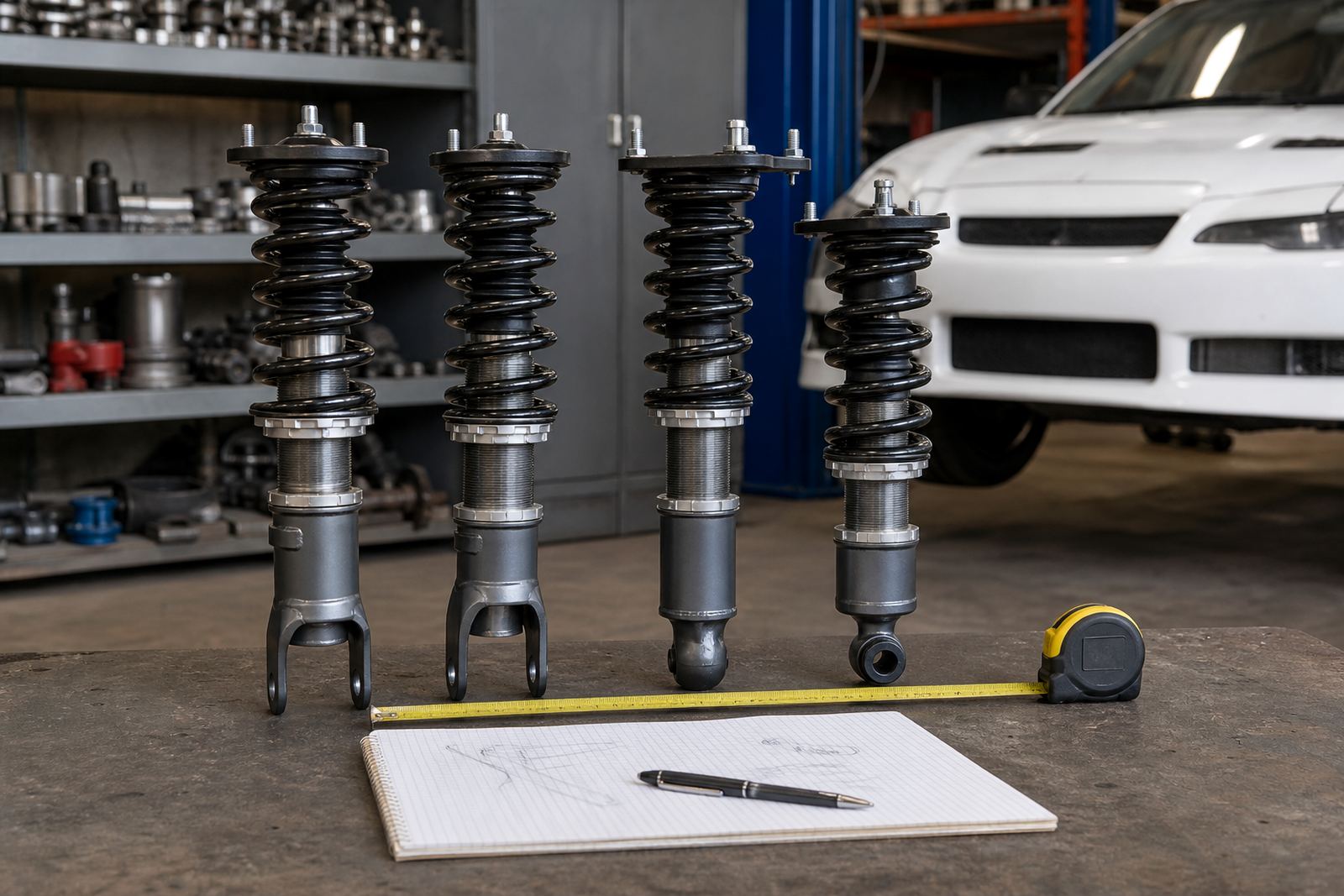
A good coilover choice begins with the chassis, tyre size and the sort of laps or stages the car runs. A light hatch on narrow tyres needs a different spring and damper package from a heavier saloon that spends time on smooth tarmac or rougher rally sections.
Look at the current balance first. If the front washes wide under turn-in, or the rear feels nervous over kerbs and bumps, the coilover spec has to answer that behaviour rather than chase a lower stance. Ride height alone does not make a car quicker, and too little travel can turn a fast car into a tiring one.
- Note the car model, weight and wheel size
- Record the tyre type and track surface
- List the handling fault you want to fix
- Check whether the car still needs road use
Spring rates and what they change on track
Spring rate controls how much load it takes to compress the suspension. A higher rate can sharpen response and reduce roll, but if it is too stiff for the surface the tyres lose contact and the driver ends up fighting the car in braking zones and through fast direction changes.
There is no magic number that suits every build. Front engine cars often need careful front to rear balance, while cars with more rear grip may need a softer rear spring than a newcomer expects. For club racing, a medium rate that keeps the tyres working is often more useful than an aggressive setup that looks good on paper.
Ask how the spring choice fits the rest of the package. Damping, tyre sidewall, alignment and corner weighting all influence what the spring really does once the car is moving.
Damping adjustment needs a clear range
Damping controls how fast the suspension compresses and rebounds. A coilover with adjustment gives room to tune the car for qualifying, wet conditions or a rougher circuit, but only if the adjustment window is meaningful and the clicks do different things in practice.
Some systems change the car too little across the range, while others become vague when adjusted near the ends. That is why it helps to work from a known baseline and make one change at a time. If the car becomes more bouncy after a change, the rebound side may be too light. If it skips across bumps, compression may be too firm for the surface.
- Set the damper to a known starting point
- Test one end of the car before changing both
- Write down lap feel and tyre wear notes
- Return to the baseline if the change gets worse
Ride height range is about travel, not only looks
Many buyers focus on how low the car can go. On a race car, useful ride height is really about keeping suspension travel, preserving geometry and protecting the underside from kerbs, ramps and rough service roads between events.
A coilover with a practical height range should let the car sit where the geometry still works. If it is dropped too far, bump travel disappears, camber gain changes and the car may bottom out under braking. That can upset the platform more than a modest, well-set height ever would.
Check that the adjustment range still leaves room for alignment correction, tyre clearance and safe wheel movement at full lock. A neat stance means little if the car scrapes, binds or eats tyres on the inside edge.
Fitment details that save time later
Before fitting, look closely at top mounts, spring seat access, body clearance and the condition of surrounding bushes. A coilover can only work properly if the rest of the corner is not worn or misaligned. Old bushings, tired mounts and poor corner balance can hide the real gain from the new hardware.
On some cars, helper parts such as camber adjustment or top mount changes are worth planning together with the coilover. That keeps the alignment range usable and avoids a setup that looks tidy but runs out of adjustment at the first setup day.
- Inspect mounts and pick-up points for wear
- Check clearance at full lock and full compression
- Confirm the spring seats can be reached easily
- Plan alignment and corner weighting after fitment
A practical order for buying and setting up
Buy the coilover package as part of a complete setup plan rather than as a single part. The best results come when spring rates, damper settings, alignment and corner weighting are handled together, then checked after the first few outings.
For drivers in Midrand, Johannesburg, Pretoria, Kyalami, Durban, Cape Town and other race centres, the same sequence still applies. Start with the car’s current behaviour, choose the parts that suit that behaviour, then use a proper setup session to settle the chassis. A coilover is not finished on the day it is fitted, it becomes useful once the car is measured, driven and adjusted with care.
If you want to talk through spring rate choice, damping range or ride height for a track, rally or club car, send the details through our contact form.
Buying checklist before the first fitment
Keep the final decision grounded in measurable details. A good purchase should answer how the car will be used, what the roads or circuits are like and how much adjustability the driver will really use.
- Vehicle make, model and year
- Track, rally or mixed-use duty
- Desired ride height range
- Expected spring rate direction, softer or firmer
- Need for damping adjustment
- Any current handling faults or tyre wear concerns
If those points are clear, the coilover choice becomes easier to match to the car and the event calendar.