
Cabin fire kits built for fast reach
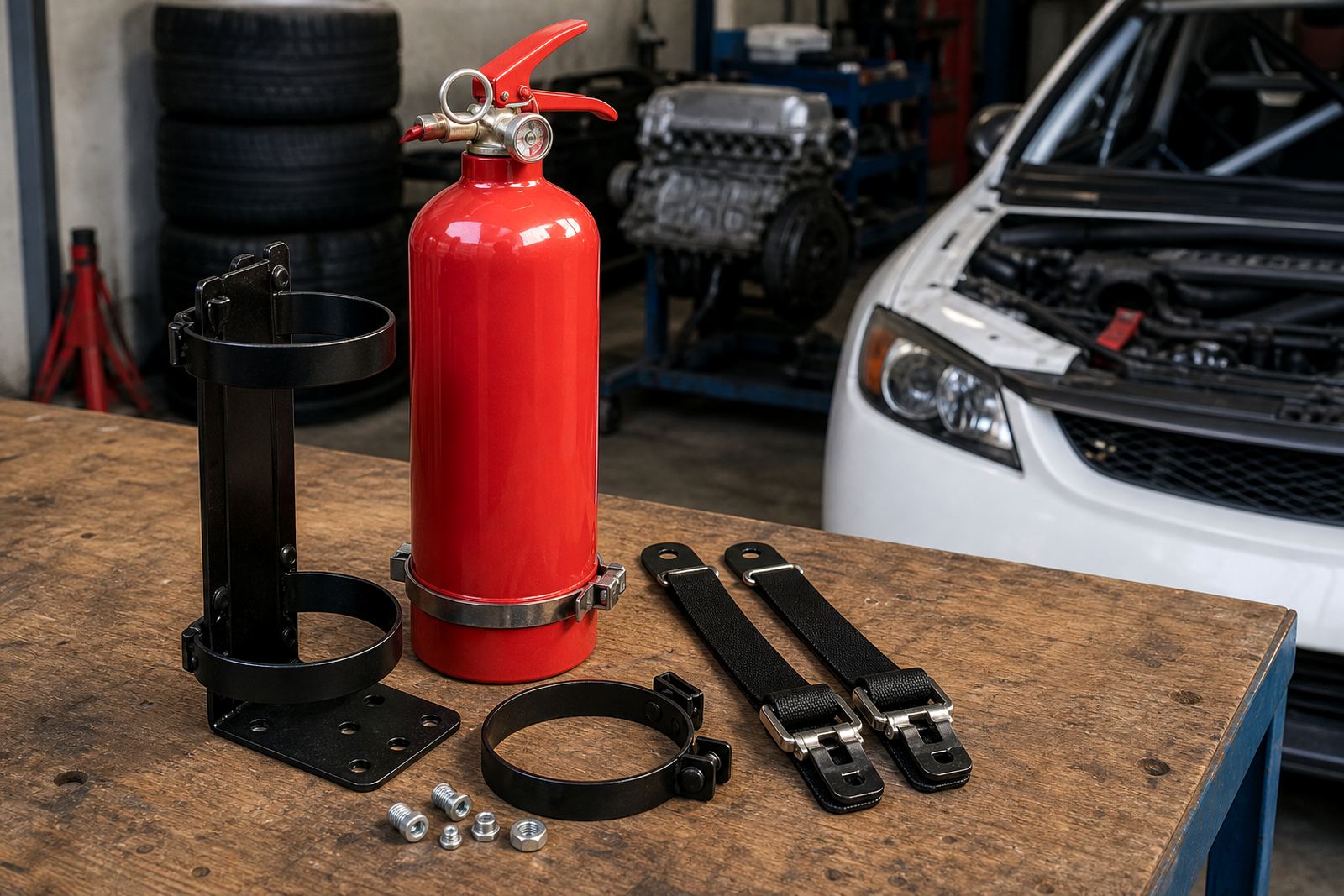
A fire kit for a race car keeps the extinguisher within easy reach of the driver or co-driver, usually on the tunnel, seat base area, or the passenger footwell on a right hand drive car. The kit normally includes the extinguisher body, a metal or composite mount, a release strap or clamp, and the fixings needed to hold everything tight through vibration, kerbs, and long runs on rougher rally stages.
For motorsport use, the practical choices are compact manual units that can be lifted out for service, or fixed with a cradle that leaves the operating pin and handle clear. The point is secure cabin mounting with a clean pull motion, not a loose bottle rolling under a seat. In the shop we look at where the driver can get a hand on it while belted in, and where the passenger or co-driver can reach it without leaning across controls.
Sizes and mounting styles that suit real race cars
Most fire kits are selected by extinguisher mass, bottle size, and the bracket style that matches the cabin. Smaller units suit lightweight club cars and tight cockpits, while larger bottles are better where the rule set or the build calls for more capacity. Common options include aluminium or steel bottles, single or twin strap mounts, and floor or tunnel brackets with through-bolts and spreader plates.
- Compact units for tight cabin packaging and lighter builds.
- Mid-size kits for touring cars, rally cars, and track cars.
- Bracket sets with steel hardware for firmer cabin fixing.
- Release straps that keep the handle area open and visible.
- Mounting plates for straight surfaces, tunnel sections, or seat frames.
Where space is limited, we usually work around seat rails, harness hardware, and control reach first. A fire kit should sit where it stays solid under braking and cornering, not where it becomes an awkward obstacle. Midrand customers often bring the car in with the seat position already set, which helps place the kit properly the first time.
Where these kits suit best
Fire kits belong in any car that sees grids, stages, or repeated practice days, especially where scrutineering looks closely at safety equipment. They are common in club racing hatchbacks, sedan builds, rally cars with stripped interiors, and track machines that still carry a passenger seat or co-driver space. The important part is matching the kit to the cockpit layout and the series rules, because some classes are stricter than others on mounting position and accessibility.
In Gauteng, we often fit fire kits alongside seat positioning, harness fitment checks, and roll cage advice, since all three affect where the bottle can sit. A badly placed extinguisher can clash with a cage tube, interfere with harness pull angles, or block a clean exit from the car. That is why the mount should be planned with the rest of the cockpit, not added as an afterthought the night before an event.
Fitting, fixing and cabin clearance
Installation needs a steady metal base, suitable fasteners, and a location that stays clear of pedals, wiring, and seat movement. On many cars the mount is through-bolted to the floor or a rigid bracket, with large washers or backing plates underneath. We also check that the kit does not foul the seat runner, the steering movement, or the harness buckle path when the driver gets in and out.
When a car is prepared for racing use, a fire kit should be fitted so the release can be reached quickly while strapped in. The handle orientation matters, and so does the angle of the bottle body. If it sits too low or too far back, the driver may have to search for it under pressure. That is poor packaging in a tight motorsport cabin, especially in a rally car that sees dust, vibration, and uneven surfaces.
- Use proper bolts and lock nuts, not light hardware.
- Keep the bottle away from hot exhaust tunnels.
- Leave hand clearance around the release pin or strap.
- Check that seat travel does not shift the mount.
- Confirm the extinguisher can be lifted out for service.
Care, inspection and workshop handling
A fire kit needs regular visual checks, even when the car is stored between events. The bottle should stay secure, the gauge or pressure indicator should be readable where fitted, and the bracket should not loosen from vibration. In humid conditions, especially around coastal racing trips to Durban or long storage in Cape Town, metal parts and fixings deserve an extra look for surface corrosion.
We usually advise owners to keep the mount clean and dry, and to avoid hanging helmets, tools, or cables on the same bracket. If the car is washed with a strong hose, check the release points and the bottle label area afterwards, because dirt and moisture can hide damage. A fire kit is one of those pieces that must stay ready, not buried under junk in the cabin.
Details to confirm before ordering
Before placing an order, it helps to confirm the vehicle type, cabin layout and the space available for the bracket. You should also know whether the car runs with a front passenger seat, a co-driver seat, or a stripped passenger side, because that changes the best mounting position. The final choice can also depend on whether you want a compact unit for a tight door opening or a larger kit for wider cabin access.
We also ask for the intended use, track, rally, or club racing, and the class rules if the car runs under a formal series. That lets us check the likely mounting position and whether the kit should sit on the floor, tunnel, or seat frame. If you are collecting parts with other safety items, we can match the fire kit with harness fitment, seat positioning, and cage clearance at the same time.
- Vehicle make, model, and cabin layout.
- Driver or co-driver reach from the seated position.
- Preferred mounting area and available flat surface.
- Any scrutineering or class rule points.
- Whether you want a compact or larger extinguisher kit.
Midrand supply for race prep and setup days
RaceHouse works from Midrand with motorsport parts and performance upgrades for track, rally, and club racers across South Africa. Fire kits sit naturally alongside brake upgrades, suspension setup, cooling checks, and cockpit safety items, because a race car is easier to manage when the driver can reach the right gear without searching. Our team handles supply with practical fitting advice, and on setup days we can look at the cabin layout as part of the wider package.
Drivers from Johannesburg, Pretoria, Kyalami, Centurion, Durban, Cape Town, and Port Elizabeth often need the same thing: a fire kit that is easy to reach and solidly mounted. That means the bracket, the bottle size, and the cabin position all matter. Thabo Chetty leads the team, with support from Anele Malherbe, Johan Gumede, Lerato Ncube, Morne Naidoo, Sibusiso Mashaba, and Candice Phiri, each handling the details that keep a race car tidy and ready for scrutineering.
Key facts
| Type | Manual fire extinguisher kit for motorsport cabins |
|---|---|
| Mounting | Secure cabin bracket with strap or cradle fixing |
| Use cases | Track cars, rally cars, club racing cars |
| Sizes | Compact and mid-size extinguisher options |
| Fitment | Floor, tunnel, or seat frame mounting depending on cabin space |
| Care | Regular visual checks, dry storage, and corrosion monitoring |