

What a catch can does in a race car
A catch can sits in the breather path and gives oil mist, fuel vapour and condensation somewhere to slow down before the air is routed on. On hard-driven motorsport engines, crankcase pressure pulses push vapour through the breather line, and a proper tank separates some of that carry-over instead of letting it coat the intake pipework, throttle body or intercooler side of the bay.
In practical terms, that means less oily residue around hoses and unions, and a cleaner spot to spot leaks after a session. On turbo builds it is often used with the right separator setup, while naturally aspirated cars may suit a compact tank with a drain point and a vent or return layout matched to the build. The exact routing depends on the engine family, bay layout and how the car is used on track.
For track cars running long stints, a catch tank is part housekeeping and part engine control. It will not fix worn rings, blocked breathers or a badly routed hose, but it does help manage what the engine throws off under load.
Tank sizes, filter styles and mounting options
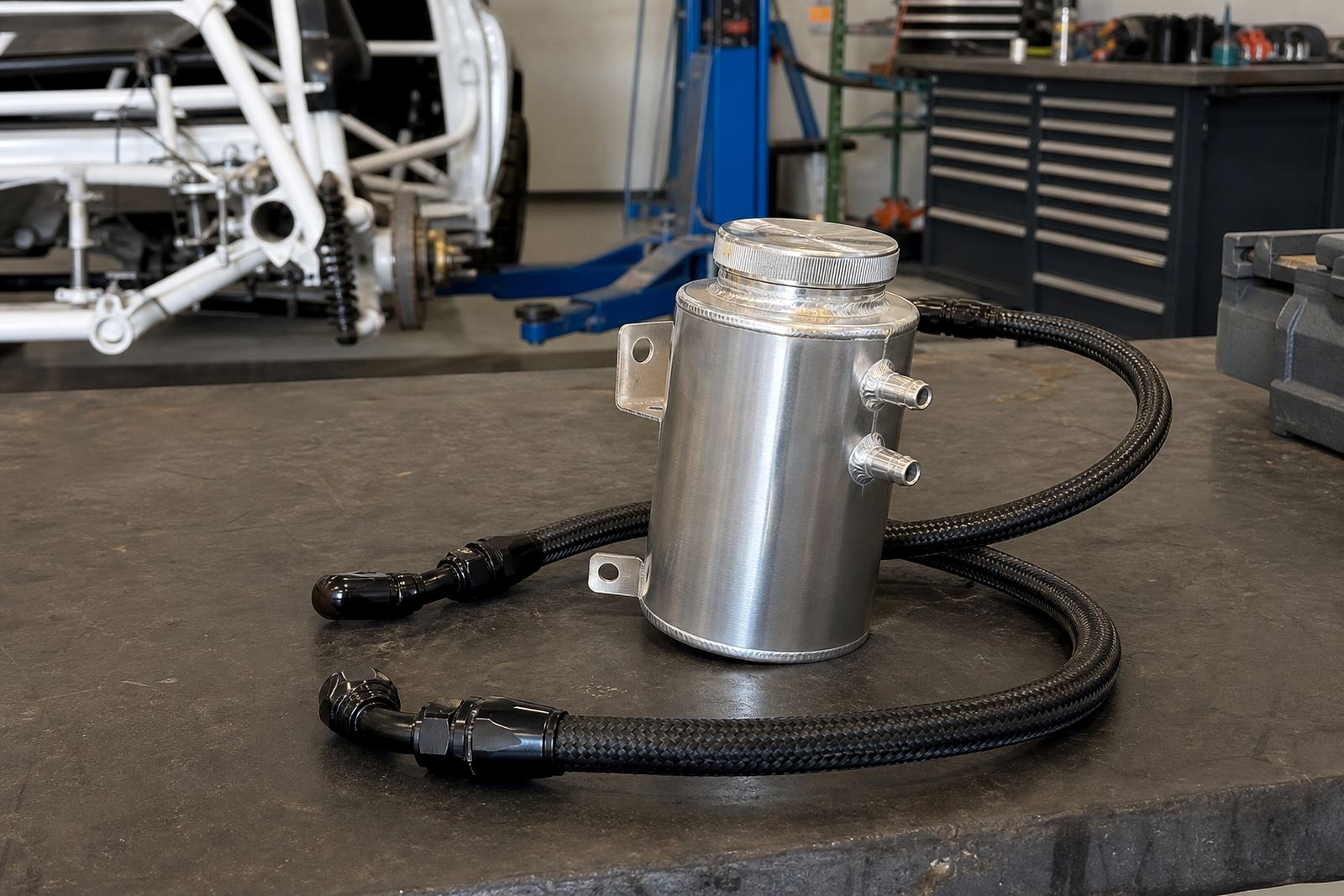
Most motorsport catch cans are chosen by volume, port size and how much space the bay allows. A small 300 ml to 500 ml tank suits tighter bays and lighter use, while 1 litre to 2 litre units are common on engines that breathe harder or carry more vapour on long sessions. Some tanks use internal baffles, mesh or swirl plates to slow the vapour and encourage the oil droplets to drop out before the air exits.
We can match the tank to the hose size and the mount point so the lines run cleanly and do not rub on hot or moving parts. Aluminium tanks are common for racing use, with welds that can handle repeated heat cycles better than thin generic hardware. In a humid coastal area, a clean drain point matters because moisture gathers in the can too, not just oil.
- Can sizes: 300 or 500 ml, 1 or 2 litres
- Typical hose sizes: 10 mm, 12 mm, 16 mm and 19 mm barbed fittings
- Mounting types: bulkhead bracket, chassis leg mount, remote firewall mount, adjustable clamp bracket
- Feature options: sight tube, drain tap, baffle insert, removable lid, serviceable filter element
Where catch cans suit the way motorsport cars are used
Catch cans suit cars that spend time at high rpm, cars with increased blow-by from fresh engines, and builds where the intake path needs to stay cleaner between checks. They are useful on circuit cars, rally cars and club racers that get loaded harder than a road car. On turbocharged builds, they help keep mist and sludge from moving through the charge side and into places where it is awkward to clean out later.
They also make sense where scrutineering and maintenance matter, because a tidy catch tank setup helps show what is happening inside the motor. If the can fills quickly, that can point to a breathing issue or excessive pressure, and that is useful information before a bigger problem starts to show itself. In some cars the tank is plumbed into the breathing circuit with a return, in others it is vented and collected for manual draining, depending on the class rules and the build plan.
- Track days and club racing cars with regular high-rpm running
- Rally cars that see dust, heat and rougher vibration
- Turbo and supercharged engines with more vapour carry-over
- Fresh engines that need close checking during early heat cycles
Fitting needs, hose routing and bracket placement
A catch can needs proper routing if it is going to do its job. The hose runs should avoid sharp bends, hot turbine areas and places where vibration will rub through the line. It also helps to mount the tank where the lid can be opened and drained without removing half the bay, because the job is neater when servicing stays quick and clean.
For a motorsport installation, we look at the breather source, the outlet path, the available return point and the best place to secure the can. Some setups need a one-way valve arrangement, while others work better with a direct separator route and a drain tap. The fittings need to match the hose ID and the engine ports exactly, or the result ends up loose, noisy or prone to seepage.
If the car already has a tight bay with an oil cooler, boost pipework and front mounted radiator hardware, placement matters even more. The tank should be accessible without crowding the rest of the service points. A neat install also makes it easier to spot whether the can is filling too fast, or if a line has picked up a kink after heat and vibration.
Care, draining and what to watch after sessions
Catch cans need routine attention. The collected oil and condensation should be drained before the tank overfills, because once it is full the vapour starts moving on again and the mess returns to the intake side. In cooler weather or during stop-start running, the can can collect a milky mix of oil and moisture, especially on short circuits and cold starts. That is normal to a point, but it still needs checking.
We suggest looking at the drain condition, the hose clamp tightness and the baffle state during regular service intervals. If the can has a filter element, that element should be kept clean and seated correctly. Threads and O-rings also need a quick look because a small seep at the lid becomes a bigger problem once the car is on rougher ground or held at higher rpm for longer.
- Drain the tank before it reaches the top mark
- Check hose ends for soft spots, kinks or oil sweating
- Inspect the mounting bracket after vibration-heavy events
- Confirm the lid seal and drain tap are not weeping
Details to confirm before you order a catch tank
The right catch can starts with the engine layout, the breather hose size and the way the car is used. We need to know whether the car is naturally aspirated, turbocharged or supercharged, whether the tank will return to the engine or stay as a vented system, and how much room there is in the bay. Port sizes, thread types and the available mounting face all affect the final fit.
It also helps to know whether the build is for circuit, rally or mixed use, because that changes how the parts need to be packaged. A tight bay on a front-wheel-drive car may need a different bracket than a rear-drive car with more open space. If you are dealing with a modified sump, catch can plumbing can need a second look as well, since the crankcase side should not be guessed at.
When you send through the details, include the vehicle model, engine code if known, breather hose diameter, mounting space and whether you want a drain tap, sight tube or serviceable filter. That keeps the spec grounded in the actual car rather than a generic box of parts.
Midrand motorsport support for cleaner breathing systems
RaceHouse works with motorsport parts and performance upgrades from our Midrand base, supporting track, rally and club racing cars across Johannesburg, Pretoria, Kyalami, Centurion, Durban, Cape Town and Port Elizabeth. Catch cans often sit alongside brake, cooling and suspension work, so the advice needs to fit the rest of the car and not just one small part of it.
Our team can talk through mounting, hose layout and service access, and on some builds that goes together with setup days where the car is assessed as a whole. A catch tank is a small part, but on a hard-used machine it plays a useful role in keeping the bay easier to live with and easier to inspect. That matters when the car is worked hard and the bay already carries enough heat, grime and movement as it is.
For product confirmation, use our contact form and include the car details, hose size and whether you want a compact tank or a larger separator style. If you already have the car apart, photos of the bay and the existing breather routing help a lot more than a vague note.
Key facts
| Product type | Breather and oil catch tank for motorsport use |
|---|---|
| Typical capacities | 300 or 500 ml, 1 or 2 litres |
| Common materials | Aluminium tank, alloy fittings, serviceable lid and seals |
| Typical hose sizes | 10, 12, 16 or 19 mm |
| Mounting styles | Firewall bracket, chassis mount, bulkhead mount, adjustable clamp mount |
| Use cases | Track, rally and club racing engines with breather vapour management |