

Isolation hardware that suits a race car, not a road habit
A battery cutoff switch sits between the battery and the car's electrical system, then breaks the circuit when it is turned off or pulled. In motorsport, that matters for scrutineering, pit lane safety and incident control, especially on cars that run with the battery in the boot, behind the seats or in a sealed tray. We supply external and cabin types for track cars, rally cars and club racers that need a clean, clearly marked shut-off point.
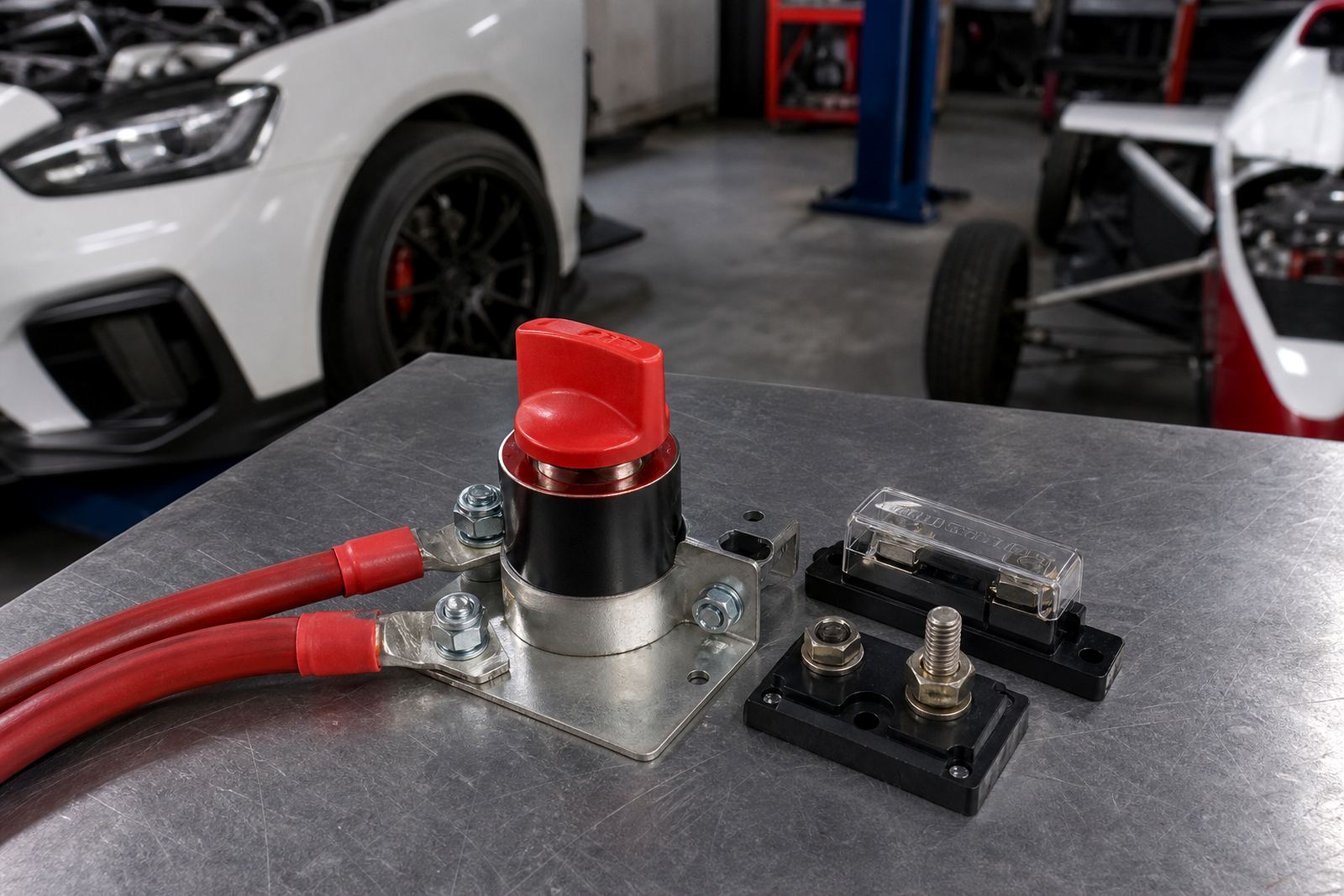
The usual racing switch is a heavy duty rotary or pull type unit with clearly marked ON and OFF positions. External versions are placed where marshals can reach them from outside the car, while cabin switches are fitted within the driver area for quick use by the crew. The better units are built for high current handling and a firm mechanical action so they stay reliable through vibration, heat and repeated use.
- External master cutoff switches for marshal access
- Cabin isolate switches for driver and crew use
- Rotary and pull-action designs
- Units suited to battery relocation and loom isolation
- Options for race cars with a live alternator circuit
Where the switch fits into a proper safety layout
Battery cutoff switches are common on rally cars, tin tops, club racing hatchbacks and modified saloons with moved batteries or more than one electrical feed. They also suit cars that carry a fire bottle system, fuel pump circuit, data logger or added cooling fans, because the isolation point needs to be placed with the rest of the electrical plan in mind. On some builds the switch is used together with a firewall pass-through and a battery clamp tray, so the whole layout stays tidy and serviceable.
Mounting position counts as much as the part itself. An external switch must be easy to identify from the outside of the car, and the cable route must be protected from chafing, heat and sharp edges. Cabin switches usually sit within reach of the driver or co-driver, but not where an elbow or harness buckle will knock them loose.
- Track cars with relocated batteries
- Rally cars that need outside access for safety crews
- Club racers with basic electrical isolation requirements
- Cars with added cooling, lighting or data systems
- Projects that need a clearer kill point for scrutineering
Sizes, ratings and the bits that need matching
Most motorsport cutoff switches are selected by current rating, terminal style and mounting format. The exact choice depends on whether the car uses a single battery, an alternator circuit, a starter feed or a battery master relay arrangement. Some switches are plain cut-off units, while others are designed to work with alternator discharge protection so the engine does not keep feeding the electrical system after the battery line is opened.
For typical race use, the switch must suit the cable size and the expected current draw. Heavy cable installations often use larger lugs and a stronger mounting panel, while lighter cockpit isolation jobs can use more compact hardware. The body, handle and fixings should match the space in the car, especially where there is little room near the seat base, sill, boot floor or rear bulkhead.
- Current ratings matched to the vehicle electrical load
- 6 mm, 8 mm or larger terminal studs on many units
- Panel mount and bulkhead mount options
- Rotary knob or pull handle operation
- Some units include alternator discharge contacts
Fitment details that keep the car neat and usable
Fitting a battery cutoff switch is not just a matter of bolting it in place. The cable ends must be crimped properly, the mounting face needs to be solid and the route should avoid heat from exhausts, turbo piping or brake lines. On cars that see gravel stages or wet conditions around Durban or Cape Town, sealing and cable protection matter because spray and dust work their way into weak joints.
Our fitting advice covers switch position, cable length, label placement and how the driver or marshal will reach the unit in a hurry. Where needed, we also help with battery tray position, earth lead routing and whether the alternator circuit should pass through the cutoff or be wired separately. If the car runs a simple stripped cabin or a full cage, the switch needs to sit where it can be used without fouling the seat, belts or the door bars.
- Correct cable sizing and lug selection
- Crimping and insulation on the main feed
- Mounting plates for thin panels or tubular structures
- Labelled ON and OFF positions for quick identification
- Clear access from outside or inside the car, depending on the build
Care, checks and what wears out first
Battery cutoff switches are simple parts, but they still need inspection. Check for loose fasteners, heat marks around the terminals, cracked bodies and any sign that the contacts are getting rough. A switch that feels sticky or needs extra force should not be left until the next event, because vibration and heat cycles can make the fault worse. On cars that race often, the wiring around the switch should be checked at the same time as wheel bearings, brake pads and harness mounts.
Try to keep the unit free of dirt and moisture where you can. Mud, brake dust and loose boot contents can interfere with the handle or rotary action, especially on cars that are trailered between events. If the battery is removed for storage, the switch should still be operated from time to time so the mechanism stays free, and the terminals should be protected from corrosion with the right cover or insulating boot.
- Inspect terminal tightness before event days
- Watch for heat discolouration near the lugs
- Keep the switch clear of mud, grit and loose tools
- Replace damaged covers, boots or labels
- Check the operation after any wiring change
Confirm before you order
Give us the car model, battery position and whether the switch must be reachable from outside, inside or both. It also helps to know the cable size, whether the alternator stays connected through the switch, and if the car already has a cage, seat, fuel cell or rear bulkhead panel that affects the mounting point. Those details shape the hardware choice and the cable ends that will suit the install.
If you are setting up a new build in Midrand, Johannesburg, Pretoria, Kyalami, Centurion, Durban, Cape Town or Port Elizabeth, the best result comes from matching the switch to the rest of the electrical and safety layout. Our workshop team works with race prep jobs that need practical parts, fitment guidance and clear mounting advice, not a loose guess at the parts counter.
- Car make, model and competition class
- Battery location and cable run length
- External, cabin or combined access requirement
- Terminal type, stud size and cable gauge
- Any alternator isolation requirement
Key facts
| Product type | Battery cutoff switch for motorsport isolation |
|---|---|
| Access styles | External marshal access and cabin-mounted driver access |
| Common operation | Rotary or pull-action cut-off |
| Typical fitment | Boot, rear bulkhead, cockpit side panel or rear panel |
| Electrical use | Main battery isolation, with some units suited to alternator discharge control |
| Use case | Track, rally and club racing cars with safety-focused electrical layout |